




Table of Contents
Submit the Form Below to Unlock Up to 20% Discount
Organic search still drives over 50% of all website traffic globally in 2026. Yet Indian businesses collectively spent an estimated ₹70,000 crore on digital advertising last year — and a significant chunk of that was wasted on the wrong channel, at the wrong time, for the wrong business.
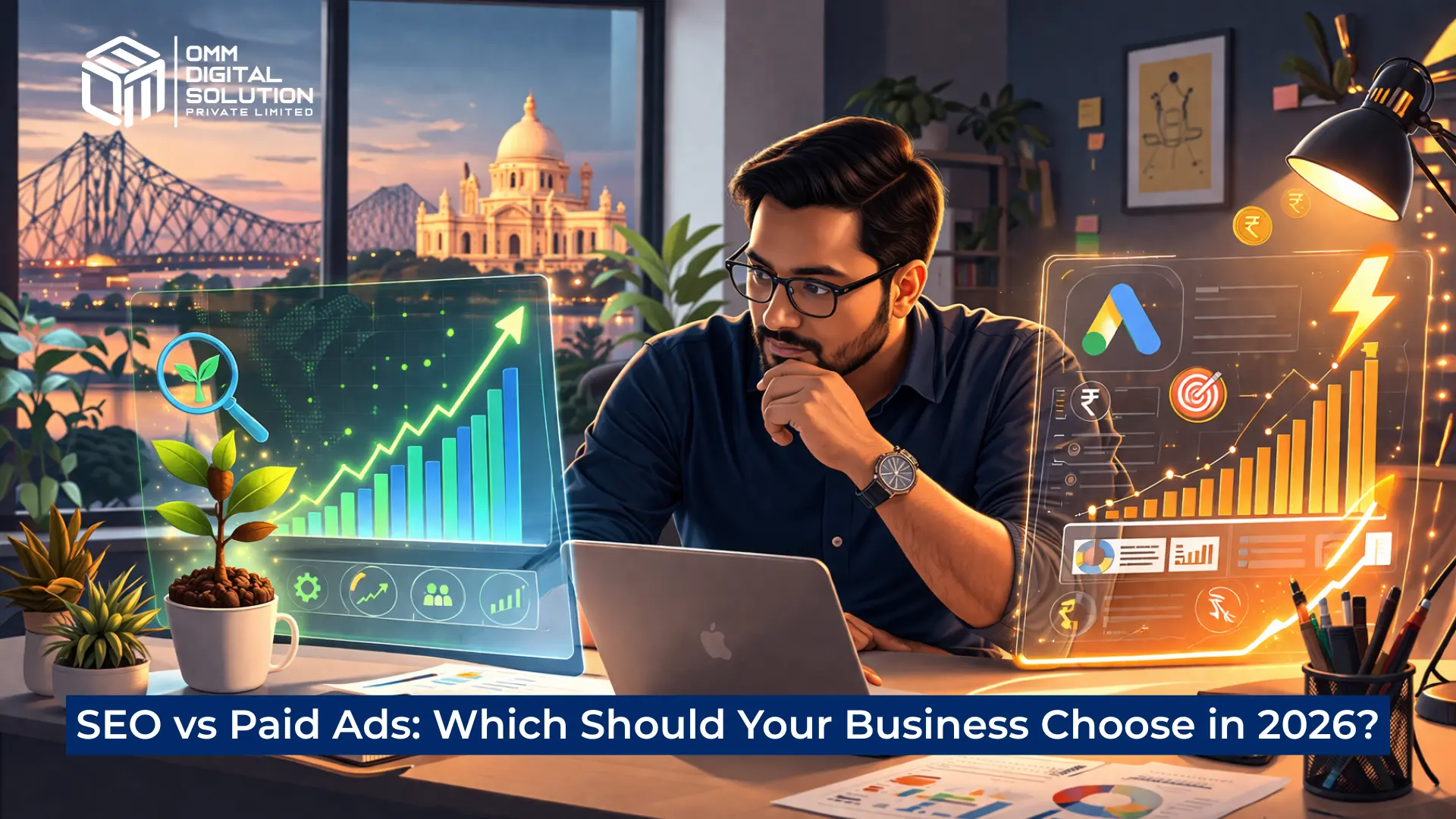
The question is not whether SEO or paid ads work. Both work. The real question is: which one is right for YOUR business, at THIS stage, with YOUR budget?
Most articles on this topic will tell you to “use both.” That is a non-answer. This guide gives you a clear decision framework – including six real business scenarios – so you can leave this page knowing exactly where to put your next rupee.
| What you will learn in this guide: |
| The real difference between SEO and paid ads — in plain language |
| A head-to-head comparison across 6 key factors with a clear winner for each |
| A 6-scenario decision framework: which channel wins for YOUR specific situation |
| Real INR cost data and ROI timelines for Indian businesses in 2026 |
| The smartest combined strategy used by India’s fastest-growing SMBs |
| A free strategy call offer at the end — no sales pitch, just honest advice |
The Core Difference: What SEO and Paid Ads Actually Are
Before comparing them, let us define them simply — without jargon.
SEO (Search Engine Optimisation) is the process of earning your position on Google’s search results page. You optimise your website’s content, technical structure, and credibility so Google ranks you organically — without paying for each click. Think of SEO as building a house: it takes time and effort upfront, but once built, it is yours.
Paid Ads (PPC — Pay Per Click) is renting your position on Google or social media. You pay each time someone clicks your ad. The moment you stop paying, the traffic stops. Think of paid ads as staying in a hotel: comfortable and immediate, but the room is not yours when you check out.
How SEO Works (and Why It Takes Time)
Google ranks websites based on hundreds of signals — the quality and depth of your content, how many other credible websites link to yours, how fast and mobile-friendly your site is, and how well your pages match what searchers are actually looking for.
Building all of this takes time. A new blog post does not rank on day one. A new website does not appear on Page 1 in the first month. But the compounding effect is powerful: every piece of content you publish, every backlink you earn, and every technical fix you make adds to a growing foundation that generates traffic 24 hours a day, 7 days a week — without any ongoing ad spend.
| Real example: |
| A Kolkata-based clinic we worked with invested in SEO for 6 months. In month 7, their blog posts began ranking on Page 1 for 14 different keywords. By month 12, they were receiving 200+ organic enquiries per month — at zero additional cost per enquiry. That same traffic via Google Ads would have cost approximately ₹3,00,000/month in ad spend. |
How Paid Ads Work (and Why They Stop When You Do)
Google Ads (formerly AdWords) and Meta Ads (Facebook and Instagram) put your business at the top of search results or social feeds immediately — in exchange for a fee every time someone clicks. You control who sees your ad, when they see it, and exactly how much you spend.
The results are fast and measurable. A Kolkata clothing brand can launch a Durga Puja campaign on Monday and have their ad in front of 50,000 potential customers by Tuesday. The moment that budget runs out, the traffic drops to zero. There is no residual benefit, no compounding effect, no asset that remains after the campaign ends.
This is not a flaw — it is simply the nature of the channel. Understanding this is the key to deciding when to use it.
Head-to-Head: SEO vs Paid Ads Across 6 Key Factors
Here is a direct, no-fence-sitting comparison across the factors that matter most to Indian small business owners:
| Factor | SEO | Paid Ads (PPC) | Winner |
| Speed to results | 3–6 months minimum | 24–72 hours | Paid Ads |
| Short-term cost | ₹10k–₹40k/month retainer | ₹5k–₹50k/month + ad spend | SEO |
| Long-term cost | Cost per lead decreases over time | Flat or rising (CPC inflation yearly) | SEO wins |
| User trust / CTR | Users click organic 70% more than ads | Many users skip or distrust ads | SEO wins |
| Targeting control | Broad — Google-controlled audience | Precise: location, age, income, device | Paid Ads |
| Longevity | Rankings persist even if you pause spending | Traffic = zero when budget stops | SEO wins |
| 24-month ROI | Compounds — improves monthly as it matures | Flat — costs more as CPCs rise | SEO wins |
| Combined potential | Strong foundation + credibility | Fast traffic + precise targeting | Both |
Speed: Which Delivers Results Faster?
Paid Ads wins — and it is not close. A well-set-up Google Ads campaign can have your business appearing at the top of search results within 24 hours of launch. For businesses that need leads immediately — a new restaurant opening, a seasonal offer, a product launch — this speed is irreplaceable.
SEO is a 3-to-6-month minimum commitment before meaningful results appear. New websites in competitive Kolkata markets can take 8–12 months to rank on Page 1. This is not a weakness of SEO — it is simply the time required to build genuine authority. But if you need revenue this month, paid ads are the only realistic option.
Cost: Which Is Cheaper Short-Term vs Long-Term?
This is where the comparison becomes genuinely interesting — and where most articles get lazy with generic global figures. Here are real 2026 numbers for the Indian market:
- SEO retainer in India: ₹10,000 – ₹40,000/month depending on competition and scope. The traffic this generates costs you nothing per click — ever.
- Google Ads in India: Management fee of ₹8,000 – ₹25,000/month plus actual ad spend. In competitive sectors like real estate, education, and healthcare, CPCs (cost per click) range from ₹80 to ₹400 per click — and rise roughly 15–20% each year as more businesses compete for the same keywords.
The compounding math: Suppose you spend ₹20,000/month on SEO. In month 6 you get 20 organic leads — cost per lead: ₹6,000. In month 18, the same ₹20,000/month generates 90 leads — cost per lead drops to ₹1,333. With paid ads, if you spend ₹20,000/month in month 1 and get 20 leads (₹1,000/lead), in month 18 you are likely spending ₹28,000+/month for the same 20 leads due to CPC inflation — cost per lead: ₹1,400 and rising. SEO wins decisively over 18+ months.
Trust and Click-Through Rate: Do Users Prefer Organic or Ads?
SEO wins — and Indian consumers have become more ad-savvy than ever, especially in the post-COVID digital boom. Research consistently shows that organic search results receive approximately 70% more clicks than paid ad listings for the same keyword.
The reason is simple: most users understand that paid results are paid for. An organic listing — especially one with strong reviews, a well-known brand name, or a rich snippet — signals credibility. For high-trust categories like healthcare, legal services, and financial products, this distinction matters even more. A clinic ranking organically for “best cardiologist in Kolkata” is perceived as more credible than one that bought that top spot.
Control and Targeting: Which Gives You More Precision?
Paid Ads wins — it is the channel’s greatest strength. With Google Ads or Meta Ads, you can target users by their precise location (specific Kolkata PIN codes), age group, household income bracket, the device they are using, the time of day, and even recent browsing behaviour.
A real estate developer in New Town Kolkata, for example, can show ads exclusively to users aged 28–50, within a 15 km radius, on weekday evenings, browsing on mobile — the exact profile of a working professional researching a home purchase after work hours. This level of precision is simply not possible with SEO, where Google controls who sees your content and when.
Longevity: What Happens When You Stop Investing?
This is arguably the most important factor for small businesses with limited budgets, and SEO wins decisively.
When you stop running paid ads, your traffic drops to zero immediately. There is no residual value, no asset that remains. Every rupee you spent is gone the moment the campaign ends.
When you pause SEO investment, your rankings decline slowly — typically over months, not days. The content you published, the backlinks you earned, and the technical authority you built remain largely intact. Many businesses take a 3-month break from active SEO and find their traffic barely changed. This is because SEO builds a genuine digital asset — your website’s authority — that does not evaporate the moment you stop paying.
ROI Over Time: The Compounding Curve
Paid ads deliver a flat ROI curve: invest ₹1, get roughly ₹X back — consistently. It is predictable and controllable. But the ratio does not improve over time. In fact, as CPCs rise each year, the ratio slowly worsens.
SEO delivers a compounding ROI curve: the same investment generates more leads in month 12 than in month 6, and more in month 18 than in month 12. Each piece of content ranks for more long-tail keywords over time. Each backlink you earn strengthens all your pages, not just one. The asset appreciates. For any business planning to operate for more than 18 months — which is every serious business — this compounding curve is the single most powerful argument for investing in SEO.
The 6-Scenario Decision Framework: Which Channel Wins for YOUR Business?
Forget generic advice. Read the scenario that most closely matches your situation right now — and follow its recommendation.
Scenario 1: You Just Launched and Need Leads This Month
| 1 | Just launched — need revenue immediatelyYou cannot wait 6 months for SEO to kick in. Paid ads are your only realistic option for immediate lead flow. | Paid Ads wins |
A brand-new business needs cash flow. Paid Google Ads can put you on Page 1 of search results within 24 hours of launching your campaign. Use this early revenue to fund your SEO investment simultaneously, so by month 6 or 7, your organic traffic starts reducing your dependence on paid ads.
For a new Kolkata business with a monthly budget of ₹20,000: put ₹12,000 into Google Ads ad spend and ₹8,000 into foundational SEO work (on-page optimisation and 2 blog posts per month). This is not either/or — it is the right sequencing.
Scenario 2: You Have a Tight Budget (Under ₹15,000/Month)
| 2 | Tight budget — under ₹15,000/month totalAt this budget, spreading across both channels gives you too little of each to work. Concentrate on SEO. | SEO wins |
Running Google Ads on a very small budget in a competitive Kolkata market often means paying high CPCs for minimal traffic. Your ₹10,000 in ad spend buys you 100–200 clicks in a competitive niche — not enough volume to learn, optimise, or generate consistent leads.
At this budget level, invest everything in local SEO: Google Business Profile optimisation, on-page SEO, and 2 blog posts per month targeting specific Kolkata keywords. Results will take 4–5 months, but they will be sustainable. Once your organic traffic generates revenue, reinvest a portion into paid ads.
Scenario 3: You Run a Seasonal or Event-Based Business
| 3 | Seasonal business — Durga Puja, wedding season, festive salesSEO cannot be turned on and off for seasonal peaks. Paid ads are built for exactly this. | Paid Ads wins |
If your business has predictable seasonal peaks — a catering company that thrives during wedding season, a gift shop that sells most of its inventory during Durga Puja and Diwali, a travel agency that peaks in summer — paid ads are the right tool. You turn them on 3–4 weeks before the peak, run them intensely through the peak, and turn them off when the season ends.
SEO can complement this by building year-round content (“best wedding catering in Kolkata” or “Durga Puja gift ideas”) that generates off-season enquiries and keeps your brand visible 12 months a year. But for in-season surge traffic, paid ads are irreplaceable.
Scenario 4: You Want Sustainable Leads 12 Months from Now
| 4 | Thinking long-term — want leads without paying per click foreverThis is SEO’s home ground. Invest now, compound for years, own your traffic permanently. | SEO wins |
If you can absorb a 5–6 month ramp-up period and are thinking about your business’s digital presence 2–3 years from now, SEO is the single best investment you can make. Every blog post you publish, every keyword you rank for, and every backlink you earn builds an asset that generates leads at decreasing cost over time.
A Kolkata coaching institute that ranks on Page 1 for “best IIT-JEE coaching in Kolkata” receives hundreds of monthly enquiries with zero ad spend. Getting there took 8 months and ₹20,000/month in SEO investment. Maintaining that ranking now costs ₹12,000/month. The maths of compounding make this the highest-ROI digital marketing channel over any 24-month horizon.
Scenario 5: You Are in a Highly Competitive Industry
| 5 | Highly competitive — real estate, finance, education, healthcareYou need paid ads for immediate leads while SEO fights the long battle for organic authority. | Both (in sequence) |
In industries where CPCs are high (₹200–₹400/click for real estate and finance keywords in Kolkata) and SEO competition is fierce, neither channel alone is sufficient. The winning strategy is to use paid ads for immediate lead flow while simultaneously building SEO as a long-term moat.
Over time — typically 12–18 months — as your SEO authority grows, you shift budget away from paid ads and toward SEO. Your competitor is paying ₹300/click in perpetuity; you are paying ₹0/click for the same keyword because you ranked organically. This is how the fastest-growing businesses in competitive Indian markets build a durable competitive advantage.
Scenario 6: You Sell Something Nobody Is Actively Searching For
| 6 | New or niche product — no active search demand yetIf nobody is searching for your product, SEO cannot help. Social paid ads create demand. | Paid Ads wins |
SEO is a demand-capture channel — it helps people find you when they are already searching. If you are selling an innovative product that most people in Kolkata do not know exists yet, there are no keywords to rank for. Nobody is typing “AI-powered tiffin management app” into Google.
In this case, social paid ads — particularly Instagram and Facebook ads — are the right tool. They interrupt users with relevant, engaging content and create awareness of a product they did not know they needed. Once your product gains enough recognition that people start searching for it, you layer in SEO to capture that growing search demand at a lower cost.
Real Cost of SEO vs Paid Ads for Indian Businesses in 2026
Generic global cost figures are useless for Kolkata businesses. Here are 2026 benchmarks specific to the Indian market:
SEO Costs in India: What You Actually Pay Per Lead Over Time
| Month | Monthly SEO Spend | Leads Generated | Cost Per Lead |
| Month 3 | ₹20,000 | 0–5 (rankings forming) | ₹4,000–N/A |
| Month 6 | ₹20,000 | 15–25 | ₹800–₹1,333 |
| Month 12 | ₹20,000 | 50–80 | ₹250–₹400 |
| Month 18 | ₹20,000 | 90–140 | ₹143–₹222 |
| Month 24 | ₹20,000 | 150–220 (compounding) | ₹91–₹133 |
The table above illustrates the compounding curve of SEO. The same ₹20,000/month generates more leads with each passing month as your content ranks for more keywords and your domain authority grows. By month 24, your cost per lead is a fraction of what a paid ads campaign would cost for the same volume.
Google Ads Costs in India: Rising CPCs and What They Mean for Your Budget
Google Ads CPCs in India have been rising consistently — approximately 15–20% per year in competitive sectors — as more businesses enter the digital advertising market. Here is what key industries are paying in 2026:
| Industry | Average CPC (Kolkata) | Monthly Ad Spend for 500 Clicks | Est. Cost Per Lead (3% conversion) |
| Healthcare / Clinics | ₹45–₹120 | ₹22,500–₹60,000 | ₹1,500–₹4,000 |
| Real Estate | ₹150–₹400 | ₹75,000–₹2,00,000 | ₹5,000–₹13,333 |
| Education / Coaching | ₹60–₹160 | ₹30,000–₹80,000 | ₹2,000–₹5,333 |
| Legal Services | ₹80–₹200 | ₹40,000–₹1,00,000 | ₹2,667–₹6,667 |
| Restaurant / Food | ₹20–₹60 | ₹10,000–₹30,000 | ₹667–₹2,000 |
| E-commerce / Retail | ₹30–₹100 | ₹15,000–₹50,000 | ₹1,000–₹3,333 |
These figures represent ad spend only. Add a management fee of ₹8,000–₹25,000/month for agency management of your campaigns. For businesses in the real estate, legal, or education sectors, the total investment in paid ads to generate meaningful lead volume can be significant — and remains constant or increases each year, unlike SEO costs which stay flat while delivering more.
The Smartest Strategy: How to Use SEO and Paid Ads Together
The most successful Indian SMBs in 2026 are not choosing between SEO and paid ads — they are sequencing them intelligently. Here is the three-phase framework we recommend to our Kolkata clients:
Phase 1 (Months 1–4): Use Paid Ads to Generate Revenue While SEO Builds
You need cash flow to survive. Paid ads provide immediate leads and revenue while your SEO investment is in its ramp-up phase. Allocate roughly 60–70% of your digital marketing budget to paid ads in this phase.
Simultaneously, start your SEO foundation: optimise your Google Business Profile, fix technical SEO issues on your website, and publish your first 2–3 blog posts targeting high-intent local keywords. This work will not generate traffic for 3–4 months, but starting immediately means the clock is ticking.
Phase 2 (Months 5–12): Let SEO Data Guide Your Ad Targeting
By this point, your SEO efforts are generating some organic data — you can see which keywords are gaining impressions, which blog posts are attracting traffic, and which pages have the highest dwell time. This data is invaluable for your paid ads strategy.
The keywords that are converting organically should also be your highest-priority ad groups. The blog posts generating organic traffic should have dedicated landing page variants for paid campaigns. Your SEO and PPC strategies start feeding each other. This integration alone typically reduces cost per lead by 25–35% compared to running the two channels in isolation.
Additionally, research from Indian market studies shows that brands combining content-led organic strategies with paid campaigns report a 45% lower customer acquisition cost compared to businesses running paid ads alone.
Phase 3 (Month 12 Onwards): Reduce Ad Dependency as Organic Grows
The goal of this phase is to shift your lead mix toward a healthy balance — ideally 60–70% organic, 30–40% paid. As your organic traffic grows and your cost per organic lead decreases, you gain the flexibility to reduce your ad spend without losing overall lead volume.
Many of our Kolkata clients reach a point where they run paid ads only for specific campaigns — a new service launch, a seasonal promotion, a geographic expansion — while their core lead flow comes entirely from SEO. This is the highest-efficiency state: paid ads used strategically for spikes, SEO handling the baseline.
| The bottom line on combined strategy: |
| Phase 1 (Months 1–4): 65% paid ads, 35% SEO foundation |
| Phase 2 (Months 5–12): 50% paid ads, 50% SEO — both channels feeding each other |
| Phase 3 (Month 12+): 30–40% paid ads, 60–70% SEO — organic dominates, ads used strategically |
| Result: Lower cost per lead, more sustainable growth, reduced dependency on ad spend |
Frequently Asked Questions
Q: Is SEO or paid ads better for a small business in India?
A: It depends on your timeline and budget. If you need leads within the next 30 days, paid ads are the only realistic option. If you have 6 months to invest and want sustainable, low-cost lead generation, SEO delivers far better long-term ROI. For most Indian SMBs with budgets above ₹20,000/month, the right answer is to start paid ads immediately while building SEO in parallel — then gradually shift the balance toward organic as rankings mature.
Q: How long does SEO take to show results in India?
A: For local SEO targeting Kolkata-specific keywords, meaningful results typically appear in 3–5 months. For broader, national keywords in competitive industries, plan for 6–12 months before Page 1 rankings are achieved. The timeline depends on your industry’s competitiveness, your website’s current state, the quality of your content, and how aggressively you build backlinks. A brand-new website in a competitive industry may take 12–18 months; an established website with existing authority can see results in 3–4 months.
Q: What is the minimum budget for Google Ads in India?
A: Technically, Google Ads has no minimum budget. Practically, a budget below ₹5,000/month in ad spend generates too little traffic to be useful in most Kolkata markets. For most small businesses, a starting ad spend of ₹10,000–₹20,000/month (plus ₹8,000–₹12,000 in management fees) is the minimum to generate meaningful data and leads. In highly competitive sectors like real estate and education, effective budgets start at ₹40,000–₹60,000/month in ad spend alone.
Q: Can I do SEO and Google Ads at the same time?
A: Absolutely — and in most cases, you should. Running both simultaneously gives you immediate traffic from ads while building long-term organic authority through SEO. The data from each channel also improves the performance of the other: high-converting organic keywords become your best ad groups, and ad performance data reveals which landing page messages resonate best — guiding your content strategy. Many Kolkata businesses running both channels report that the combined strategy delivers a 25–35% lower overall cost per lead than either channel in isolation.
Q: Which has better ROI — SEO or paid ads — in the long run?
A: SEO wins comprehensively over any horizon longer than 12–18 months. The compounding effect of organic rankings means the same monthly investment generates more leads each month as your content matures, your domain authority grows, and more keywords rank. Paid ads deliver a flat or worsening ROI over time as CPCs rise with increased competition. For businesses planning to operate for 2–3 years or more — which is every serious business — SEO is the highest-ROI digital marketing investment available.
Not Sure Which Is Right for Your Business? Let Us Build the Plan.
There is no single right answer to “SEO vs paid ads” — but there is a right answer for YOUR business, based on your budget, your industry, your competition, and how quickly you need results.
The six scenarios in this guide give you a starting framework. But every business has unique nuances — your competition’s current digital strategy, your website’s existing authority, your specific customer acquisition timeline, and your growth targets all affect the optimal channel mix.
In a free 30-minute strategy call with our Kolkata digital marketing team, we will:
- Analyse where your top competitors are getting their traffic — paid, organic, or both.
- Audit your current website to determine how competitive it is for SEO right now.
- Tell you exactly which channel fits your budget, your industry, and your timeline.
- Build a 12-month channel roadmap with monthly milestones, realistic lead projections, and a budget breakdown.
- Give you a clear answer — not a vague “it depends.”
| Ready to get a clear, honest answer for your specific business? |
| No sales pitch. No jargon. No obligation. Just 30 minutes with a senior digital marketing consultant who has worked with 50+ Indian businesses across SEO, Google Ads, and social media. |
| Book Your Free Strategy Call → WhatsApp Us Now |
