




Table of Contents
Submit the Form Below to Unlock Up to 20% Discount
Think about the last brand that stopped you mid-scroll. You noticed the colours, felt the tone, maybe even smiled before reading a single word. That wasn’t an accident — that was intentional brand identity at work.
Now ask yourself: when someone lands on your website, what do they feel? Confusion? Indifference? Or trust and curiosity? If you’re starting a new business — or rebuilding an existing one — getting your brand identity right from day one gives you a serious competitive advantage over businesses that simply wing it.
Here’s the truth: people buy from brands they recognise and trust. A study by Edelman’s Trust Barometer found that 81% of consumers say they need to be able to trust a brand before making a purchase. Trust is built through consistency, and consistency starts with a strong brand identity system.
In this guide, we walk you through exactly how to build a brand identity for your business from scratch — step by step, with practical advice and real-world examples. No design degree needed. No massive budget required (though if you want expert help, OMM Digital Solution is always here).
| Your brand is what people say about you when you’re not in the room. Your brand identity is what makes them say it. |
What Is Brand Identity — Really?
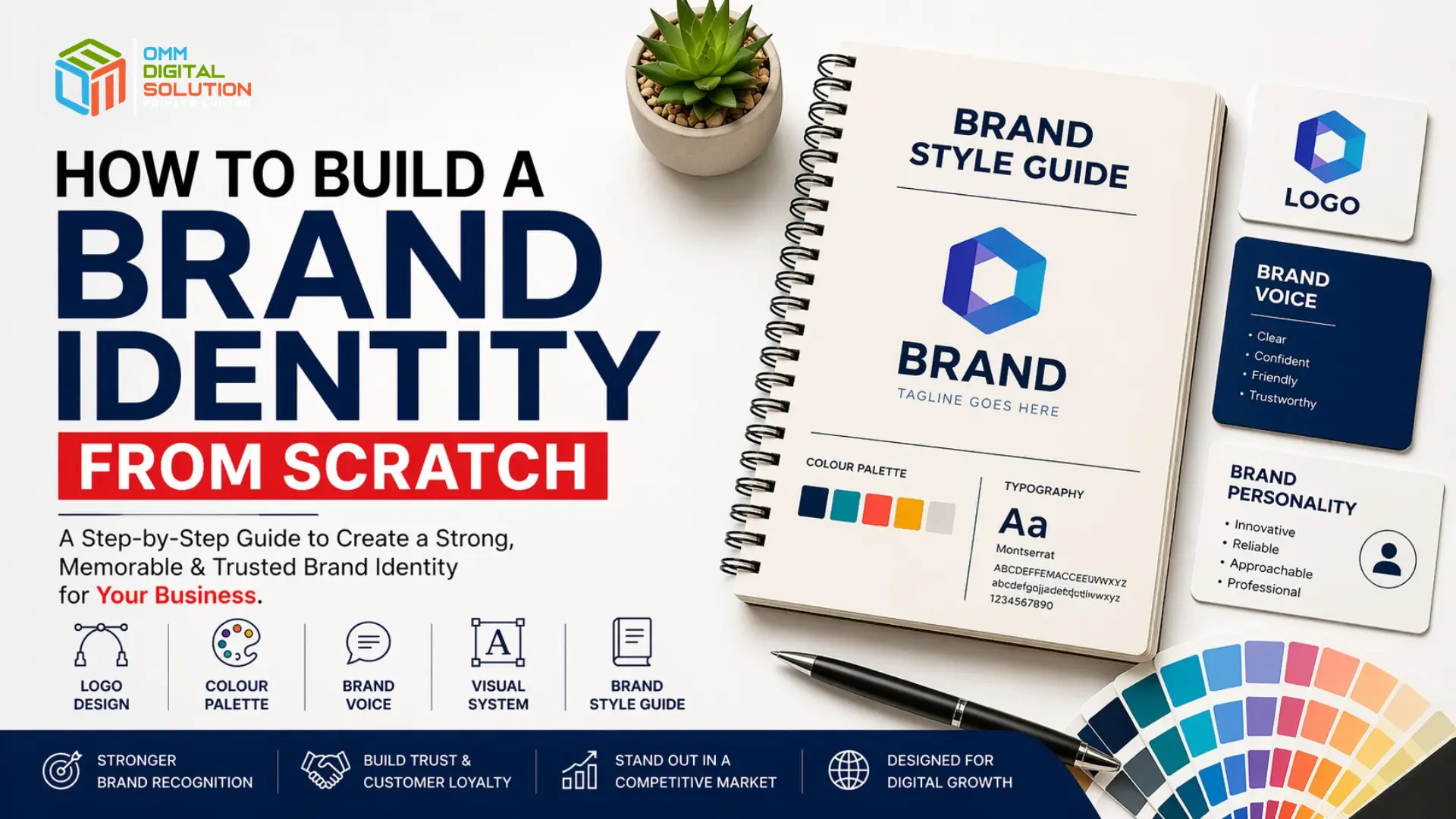
Brand identity is the complete visual and verbal expression of your business. It includes your logo, colour palette, typography, tone of voice, imagery style, and even how you write an Instagram caption. Together, these elements tell a consistent story — about who you are, who you serve, and why you’re different.
It’s often confused with “branding” (the broader strategy and overall perception) or just “a logo” (a single visual element). Brand identity sits in the middle: it’s the tangible toolkit that brings your brand strategy to life across every customer touchpoint.
According to Lucidpress’s Brand Consistency Report, consistent brand presentation across all platforms can increase revenue by up to 23%. That’s the commercial power of getting your visual identity right.
| OMM Insight: A strong brand identity doesn’t just look good — it builds trust and directly impacts your bottom line. Brands with consistent visual identity earn more recognition, generate more referrals, and command better pricing in the market. |
The 7 Steps to Build Your Brand Identity from Scratch
Here is a complete roadmap. Each step builds on the previous one — so resist the urge to skip to the design part.
1. Define Your Brand Foundation — Purpose, mission, values, and audience
2. Know Your Audience Deeply — Research who you’re genuinely speaking to
3. Craft Your Brand Personality — Tone of voice, archetype, and character
4. Design Your Visual Identity System — Logo, colours, typography, and imagery
5. Write Your Core Messaging — Tagline, brand story, and key messages
6. Build a Brand Style Guide — Document everything for consistency
7. Apply It Everywhere — Website, social, ads, packaging, and emails
STEP 01 Define Your Brand Foundation
Before you open Canva or brief a designer, you need to be crystal clear on what your business stands for. This is the bedrock that everything else is built upon. Skip this step, and your visual identity will feel hollow — pretty packaging with no substance inside.
Answer these four questions honestly — and write your answers down:
• Why does this business exist? Beyond profit, what problem are you solving or what change are you creating in the world?
• What do we stand for? Define 3–5 core values that guide every decision — from how you hire to how you handle a customer complaint.
• Who do we serve? Paint a vivid picture of your ideal customer. Not just age and location — their desires, fears, frustrations, and aspirations.
• What makes us different? Your unique positioning — the thing you do or deliver that no one else does quite the same way.
These answers become your brand compass. Every design decision, every caption, every campaign should point back to them. This is what Harvard Business Review calls “purpose-driven branding” — and it’s the single biggest differentiator between brands that build lasting loyalty and brands that stay invisible.
STEP 02 Know Your Audience Deeply
Great brand identity is not designed for you — it’s designed for your customer. The more clearly you understand them, the more your brand will resonate with them and drive real business results.
Create a detailed customer persona. Give them a name. Describe their daily routine, their goals, what keeps them up at night, which social platforms they use, and what type of content they consume. Is your ideal customer a 28-year-old first-time entrepreneur in Bengaluru? A 45-year-old retailer in Kolkata looking to take their store digital?
Use tools like Google Analytics, Meta Audience Insights, and Answer the Public to dig into what your audience is searching for, talking about, and struggling with online.
| Pro Tip: Read 10–15 online reviews of competitors in your industry. Customers spell out exactly what they want — and what frustrates them — in their own words. Mine this language for your brand messaging and positioning. |
STEP 03 Craft Your Brand Personality
Think of your brand as a person walking into a room. How do they carry themselves? What do they say, and how do they say it? This is your brand personality, and it shapes everything from your logo to your customer service emails.
One powerful framework for defining personality is brand archetypes — universal character types first outlined by psychologist Carl Jung and popularised in branding by Carol Pearson. Are you the wise Sage (Google, McKinsey)? The bold Hero (Nike, FedEx)? The playful Jester (Zomato, Dollar Shave Club)? The trustworthy Caregiver (Johnson & Johnson)?
Once you choose your archetype, define your tone of voice in practical terms. For example: “We write like a knowledgeable friend — direct, warm, and never condescending. We use short sentences. We avoid jargon. We talk with people, not at them.”
Reference: Nielsen Norman Group’s guide on brand voice is an excellent deep dive into building a tone of voice that connects with your audience.
STEP 04 Design Your Visual Identity System
Now comes the part most businesses start with — but notice it’s actually step four. Your visual identity system should express everything you’ve defined above, not exist in isolation.
Logo Design
Your logo needs to be simple, scalable, and meaningful. It should work at 16px (favicon) and at billboard size. Avoid overly complex illustrations. A strong wordmark or a clean icon mark almost always outperforms elaborate designs in digital contexts. According to MIT’s research on visual recognition, the human brain processes images in as little as 13 milliseconds — your logo has less than a blink to make an impression.
Colour Palette
Choose 1–2 primary brand colours and 2–3 supporting neutrals. Colours carry deep psychological associations: deep blues signal trust and professionalism, warm oranges convey energy and approachability, and earthy tones suggest authenticity and sustainability. Your colour palette should feel like your brand’s personality made visible. Reference Adobe Color or Coolors.co for building harmonious palettes.
Typography
Select two typefaces — one for headlines (personality, distinctiveness) and one for body text (readability, clarity). Google Fonts has hundreds of excellent free options. Your typography choices should reinforce your brand personality: a law firm and a creative agency should feel completely different just from their font choices.
Imagery Style
Define the style of photography or illustration your brand uses. Bright and lifestyle-focused? Dark and editorial? Illustrated and playful? Real and unpolished? Whatever you choose, apply it consistently. Inconsistent imagery style is one of the most common — and most damaging — brand mistakes that erodes trust without the business even realising it.
| OMM Insight: At OMM Digital Solution, we run a Brand Mood Board exercise with every client before touching any design tools. This single step aligns expectations, reveals hidden preferences, and almost always changes the creative direction for the better. It saves weeks of revision. |
STEP 05 Write Your Core Messaging
Visual identity gets attention. Words earn trust. Your brand messaging framework includes several key elements that should be defined and used consistently across every platform and piece of content.
• Tagline: A 5–8 word line that captures your brand promise. Memorable, not clever for the sake of it. Think Nike’s “Just Do It” or Apple’s “Think Different.”
• Elevator Pitch: Two clear sentences explaining who you are, what you do, and who you serve. The version you’d say to someone at a networking event.
• Brand Story: A 150–200 words narrative of your origin, mission, and why you do what you do. Goes on your About page and forms the emotional backbone of your content.
• Key Messages: 3–4 core statements about your brand that you reinforce across every piece of content. These become the themes your audience associates with your name.
• Value Proposition: A single sentence that explains the unique benefit you deliver, who you deliver it to, and why you’re better than the alternative.
A useful framework is Donald Miller’s StoryBrand methodology — detailed at Building a StoryBrand — which teaches businesses to position the customer as the hero and themselves as the guide. It’s one of the most effective approaches to brand messaging for small and growing businesses.
STEP 06 Build Your Brand Style Guide
A brand style guide is the single document that captures everything we’ve built so far — your colours (with exact hex codes), fonts (with sizes and weights), logo usage rules (including clear space and forbidden uses), tone of voice guidelines, and approved imagery examples.
This document pays enormous dividends. Whether you’re briefing a freelancer, onboarding a new team member, running ads with a media buyer, or briefing a digital marketing agency like OMM Digital Solution, your brand style guide ensures your brand looks and sounds consistent every time — across every touchpoint, every channel, every format.
Even a simple 6–8 page document is enough to start. You can build it in Figma, Canva, or even a well-formatted PDF. Look at how Mailchimp’s Content Style Guide sets the standard for consistency — it’s publicly available and worth studying for any brand serious about quality.
| What to include in your Brand Style Guide: Logo variations and usage rules • Primary and secondary colour palette with hex codes • Typography stack with size hierarchy • Photography and illustration guidelines • Tone of voice with do/don’t examples • Social media templates • Business card and letterhead standards |
STEP 07 Apply It Everywhere — Consistently
Brand identity only works through repetition. A logo seen once is forgettable. A brand encountered consistently across your website, social media, email newsletters, visiting cards, packaging, and advertising starts to build the recognition and trust that drives real business growth.
Audit every touchpoint your customer encounters and ask honestly: does this look and feel like the brand we’ve defined? Mismatched fonts on your Instagram bio, different button styles across your website pages, an outdated logo on your email signature, and inconsistent image filters on your social media posts — these small inconsistencies quietly erode credibility over time.
According to Demand Metric’s research on brand consistency, brands that present consistently across all channels see an average 33% increase in revenue. Consistency is not a design nicety — it is a business growth strategy.
| Consistency is the price of brand recognition. Pay it everywhere, every time. |
Common Brand Identity Mistakes to Avoid
• Designing before defining. Starting with the logo before knowing your audience and purpose almost always results in a costly rebrand within two years. Foundation first, always.
• Copying your competitors. Looking like everyone else in your category is strategic invisibility. Your brand identity should differentiate you, not blend you in.
• Using too many colours and fonts. Two typefaces. Three to four colours maximum. Simplicity scales across channels. Complexity doesn’t.
• Ignoring mobile-first design. Your logo, typography, and layouts must work on a 375px screen first. Over 60% of web traffic in India is now mobile, according to StatCounter.
• Never revisiting or updating your brand. Brand identity is not “set and forget.” Review and thoughtfully evolve it every 2–3 years as your business, audience, and market change.
• Undervaluing professional help. DIY branding has its place in the early stages. But as you grow, investing in professional brand identity design consistently delivers the highest ROI of any marketing spend.
Useful Tools for Building Your Brand Identity
• Canva Brand Kit — Manage logos, fonts, and colours in one place
• Figma — Professional design tool, free tier available
• Adobe Color — Build and test accessible colour palettes
• Google Fonts — Free, high-quality typefaces for web and print
• Looka — AI-powered logo generator for early-stage brands
• Coolors.co — Fast colour palette generator with export options
• Notion — Build and share your brand style guide digitally
• Answer the Public — Understand what your audience is searching for
Final Thoughts
Building a brand identity from scratch is one of the most valuable investments you can make in your business’s future. Done right, it shapes perceptions before a single word is spoken, builds loyalty that outlasts any single campaign, and makes every rupee of digital marketing spend work significantly harder.
The process does not need to be expensive or complicated — but it absolutely needs to be intentional. Take the time to define your foundation before opening any design tool. Know your audience before choosing a colour. Write your messaging before shooting your first photo. These things compound.
Start where you are, use what you have, and build a brand that earns trust at every single touchpoint. Your future customers are out there right now, forming first impressions of businesses just like yours. Make yours count.
And when you’re ready to take your brand identity to the next level — whether that’s a full brand strategy, a professional visual identity design, or a complete digital marketing rollout — the team at OMM Digital Solution is here to help.
| Ready to Build Your Brand Identity? At OMM Digital Solution, we help businesses build distinctive brand identities that attract the right customers, build trust, and stand the test of time — from strategy and naming to visual design and full digital rollout. Visit us: www.ommdigitalsolution.com Email: info@ommdigitalsolution.com | Phone: +91 8276832626 |
References
• Edelman Trust Barometer — Consumer trust research
• Lucidpress — The Impact of Brand Consistency Report
• Harvard Business Review — The Elements of Value
• Nielsen Norman Group — Brand Voice and Tone of Voice Guide
• MIT News — Visual Processing Speed Research
• Building a StoryBrand — Donald Miller’s Brand Messaging Framework
• Mailchimp Content Style Guide — Brand Consistency Reference
• Demand Metric — Brand Consistency Benchmark Report
• StatCounter — Mobile vs Desktop Market Share in India
• Adobe Color — Colour Palette Tool
