




Table of Contents
Submit the Form Below to Unlock Up to 20% Discount
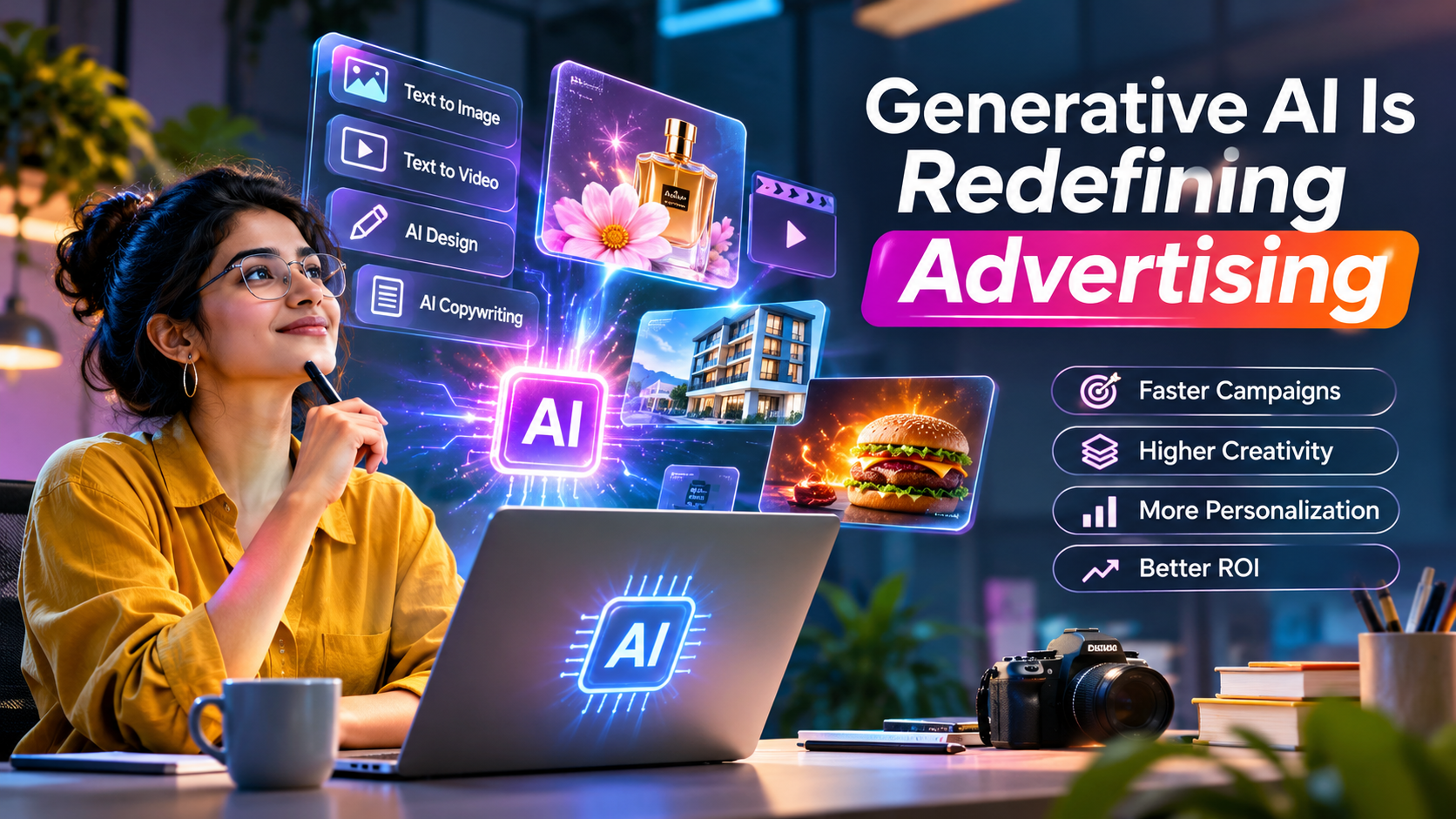
The creative industry is experiencing a transformation that goes far beyond the introduction of new software. Generative Artificial Intelligence (AI) is changing how brands develop advertising campaigns, create visual identities, produce marketing videos and communicate with their audiences. What once required multiple production stages, extensive manual work, and considerable creative resources can now be approached through a more intelligent, adaptive and collaborative workflow.
From generating campaign concepts and designing promotional graphics to developing video storyboards and producing personalised advertising content, Generative AI in advertising
is introducing new possibilities across the entire creative production ecosystem.
However, the real opportunity is not simply about creating more content in less time. It is about producing more relevant, engaging and strategically aligned content that supports measurable business objectives.
For businesses competing in increasingly crowded digital markets, this shift presents an important question: how can technology and human creativity work together to produce marketing experiences that attract attention, communicate value and encourage customers to take action?
This is where the combination of generative AI, professional creative production and integrated digital marketing becomes particularly valuable.
What Is Generative AI and Why Is It Becoming Important for Creative Industries?
Generative AI refers to artificial intelligence systems capable of creating new content based on patterns and information learned from existing data. Depending on the technology, these systems can generate written content, images, illustrations, videos, audio, animations and other creative assets.
Unlike traditional software that primarily executes predefined instructions, generative AI can interpret prompts, understand creative directions and produce multiple variations of an idea.
For example, a business launching a new product can use AI-assisted workflows to explore advertising concepts, generate visual references, develop campaign messages and experiment with different video styles before finalising its creative direction.
The technology is becoming increasingly important because modern marketing demands more than occasional promotional content. Brands need a consistent flow of creative assets for websites, social media platforms, search advertisements, digital campaigns and customer communication channels.
Producing all these materials manually can become expensive and time-consuming, particularly for businesses managing multiple campaigns simultaneously.
Generative AI helps address this challenge by supporting different stages of the creative process.
Its growing importance can be understood through five major developments:
- Creative exploration: Businesses can investigate multiple campaign concepts before selecting a final direction.
- Faster production workflows: Repetitive creative tasks can be assisted by AI-powered tools.
- Personalised communication: Visuals and messaging can be adapted for different customer segments.
- Content scalability: Marketing teams can develop more variations for different platforms and campaign requirements.
- Creative experimentation: Brands can test alternative concepts, formats and messaging approaches.
Nevertheless, AI-generated output is not automatically effective advertising. Strategic thinking, brand understanding, professional design judgement and quality control remain essential.
The most successful approach combines technological efficiency with human creative expertise.
1. How Generative AI Is Transforming Advertising
Advertising has always depended on understanding people, identifying their needs and communicating a compelling reason to choose a particular brand.
What is changing is the process through which advertising concepts are developed, produced, tested and optimised.
Generative AI is introducing greater flexibility into advertising workflows by helping marketers explore creative possibilities, develop campaign variations and adapt messages for different audiences.
AI-Powered Advertising Concepts and Campaign Development
One of the biggest challenges in advertising is developing an idea that is both original and commercially relevant.
A campaign must communicate the product’s value, connect with its intended audience and stand apart from competing messages.
Generative AI can assist creative teams during the initial brainstorming stage.
By providing relevant information about a product, target audience, campaign objective and brand personality, marketers can explore different creative directions and messaging possibilities.
For instance, imagine a furniture company launching a premium collection.
Instead of developing only one promotional concept, the creative team can explore several campaign directions:
- A lifestyle-focused campaign highlighting modern interiors.
- A product-focused campaign communicating design and durability.
- An emotional campaign connecting furniture with family experiences.
- A promotional campaign highlighting seasonal offers.
- A video-led campaign demonstrating the product in real-life environments.
AI can help develop preliminary concepts, headlines, visual references and creative variations.
The marketing team can then select the most suitable direction and refine it according to the company’s positioning.
This makes campaign development more exploratory without replacing the importance of original creative thinking.
Smarter Advertising Creatives for Digital Campaigns
Digital advertising requires multiple creative variations to accommodate different platforms, placements and audience preferences.
A single campaign may require landscape banners, square promotional graphics, vertical videos, short headlines and alternative descriptions.
Generative AI can help adapt creative concepts into different formats while maintaining the central campaign message.
For businesses investing in Google Ads and social media advertising, this can make creative experimentation more manageable.
AI-assisted creative production can support:
- Alternative advertisement headlines and descriptions.
- Different visual concepts for the same product.
- Promotional graphics for multiple placements.
- Short-form video advertisement concepts.
- Audience-specific campaign messaging.
- Variations for testing different creative approaches.
However, every advertisement should be reviewed for accuracy, brand consistency and compliance with platform policies.
The objective should not be to produce hundreds of advertisements without direction. It should be to identify which creative variations communicate the strongest value proposition and generate meaningful customer responses.
Personalised Advertising and Audience Relevance
Consumers are exposed to an enormous volume of advertisements every day. Generic messages often struggle to attract attention because they do not address individual requirements.
Generative AI makes it easier to explore personalised creative approaches.
A business can develop different messages for customers at different stages of their buying journey.
For example:
- First-time visitors may respond better to educational advertisements.
- Interested prospects may need product demonstrations or comparison content.
- Returning visitors may respond to testimonials, offers or specific product benefits.
- Existing customers may be interested in complementary products or new services.
AI-assisted workflows can help adapt advertising language and creative concepts to these different requirements.
Personalisation must still respect privacy regulations, customer consent and responsible data usage. It should improve relevance rather than create intrusive experiences.
AI and Performance-Based Advertising
The future of advertising is increasingly connected to measurable outcomes.
Businesses are not investing in campaigns simply to generate impressions. They want qualified enquiries, website visits, purchases and stronger customer relationships.
Generative AI can support the creative side of performance marketing by producing alternative concepts and helping teams develop fresh content for testing.
When integrated with campaign analytics, marketers can evaluate how different creatives perform against relevant indicators such as:
- Click-through rate.
- Conversion rate.
- Cost per lead.
- Cost per acquisition.
- Engagement rate.
- Return on advertising spend.
The important distinction is that AI can assist creative development, while campaign performance still depends on audience targeting, budget allocation, landing page quality, bidding strategies and accurate measurement.
Combining AI-assisted creative production with professionally managed Google Ads can help businesses create more structured and adaptable advertising campaigns.
2. How Generative AI Is Changing Graphic Design and Brand Identity
Design is not simply about making something visually attractive. Effective graphic design communicates a brand’s personality, creates recognition and makes information easier to understand.
Generative AI is expanding the creative possibilities available to designers by introducing new ways to explore visual concepts, develop references and accelerate selected production tasks.
However, the role of professional design is becoming more important, not less important.
As AI makes it easier for almost anyone to generate visuals, businesses need stronger creative direction to ensure their designs remain distinctive and consistent.
AI-Assisted Graphic Design and Visual Exploration
Traditional graphic design often begins with research, mood boards, sketches, references and multiple rounds of experimentation.
Generative AI can support this process by helping designers explore different visual directions.
A designer working on a restaurant campaign, for example, might explore:
- Minimalist food photography concepts.
- Premium promotional layouts.
- Contemporary typography combinations.
- Seasonal campaign themes.
- Different background and composition ideas.
These initial outputs can act as creative references rather than finished designs.
Professional designers can then refine the selected direction by correcting visual inconsistencies, adjusting compositions, applying brand guidelines and preparing production-ready assets.
This approach can make creative exploration more efficient while preserving professional design standards.
Developing Stronger Brand Identity Through AI
A successful brand identity requires consistency across every customer touchpoint.
Logos, typography, colours, graphic elements, website visuals, packaging and promotional materials should communicate a recognisable brand personality.
Generative AI can assist designers in exploring identity concepts and visual references.
For a new business, AI-assisted brainstorming may help investigate different brand personalities, such as:
- Modern and technology-focused.
- Premium and sophisticated.
- Friendly and approachable.
- Minimalist and functional.
- Bold and youthful.
The selected direction must then be developed into a cohesive identity system.
This includes professional logo design, typography selection, colour specifications, visual guidelines and appropriate usage across marketing materials.
An AI-generated logo concept should never automatically be treated as a complete brand identity. Businesses must consider originality, trademark availability, scalability, legibility and long-term brand recognition.
Professional brand design ensures that the final identity is built around business positioning rather than temporary visual trends.
Faster Production of Marketing Graphics
Businesses frequently require new graphics for social media, website banners, product promotions, event announcements and advertising campaigns.
Generative AI can help speed up parts of this process by providing visual references, generating background concepts and assisting with image variations.
Consider a company promoting a seasonal product collection.
Instead of approaching every promotional visual as an entirely separate creative project, a design team can establish a central visual direction and develop suitable variations for different campaign requirements.
This supports consistency while making the production process more adaptable.
Professional review remains necessary to ensure accurate product representation, suitable typography, correct dimensions and visual quality.
Maintaining Brand Consistency in an AI-Driven Design Environment
One emerging challenge is that AI-generated visuals can look impressive individually but may not communicate a consistent brand identity when published together.
A business might unknowingly use different visual styles, colour treatments, typography approaches and image aesthetics across its marketing channels.
Over time, this weakens brand recognition.
The solution is to develop a clear creative framework.
A professional design team should establish:
- Defined brand colours and typography.
- Consistent image treatment and visual direction.
- Approved graphic elements and layouts.
- Guidelines for promotional and informational content.
- Quality standards for AI-assisted visual assets.
AI should work within this creative framework rather than independently determining how the brand looks.
3. The Transformation of Video Production Through Generative AI
Video has become one of the most influential forms of digital communication.
Businesses use videos to introduce products, demonstrate services, explain complex ideas, promote offers, share customer experiences and communicate brand stories.
However, professional video production traditionally involves several stages, including concept development, scripting, storyboarding, shooting, editing, sound design and post-production.
Generative AI is creating new possibilities across many of these stages.
AI-Powered Video Concept Development
A successful video begins with a clear idea.
Before production starts, the creative team must understand what the video needs to communicate, who will watch it and what action viewers should take.
Generative AI can support early-stage concept development by helping teams explore different storytelling approaches.
For example, a company offering digital marketing services might want to create a promotional video.
Possible creative approaches could include:
- A problem-solution narrative highlighting business marketing challenges.
- A visual presentation explaining the company’s services.
- A customer journey showing how digital marketing supports growth.
- An educational video explaining an industry trend.
- A brand-focused video communicating the company’s philosophy.
AI can help generate initial scripts, scene descriptions and storyboard references.
The production team can then refine these ideas into a practical video concept aligned with the intended audience.
AI-Assisted Scriptwriting and Storyboarding
Scriptwriting is one of the most important parts of video production.
A visually impressive video may still fail if its message is confusing, irrelevant or poorly structured.
Generative AI can assist with:
- Initial script drafts.
- Alternative opening hooks.
- Scene descriptions.
- Voiceover suggestions.
- Dialogue variations.
- Storyboard references.
- Different video lengths and formats.
For example, a 60-second promotional video may require a completely different narrative structure from a three-minute company introduction.
AI can help explore these alternatives, while professional writers and creative directors ensure the final script sounds natural, communicates accurate information and maintains the brand’s voice.
Storyboarding can also benefit from AI-generated visual references, allowing the production team to understand the intended sequence before committing resources to production.
AI in Video Editing and Post-Production
Video editing involves selecting footage, arranging scenes, maintaining continuity, adjusting sound, adding transitions and creating a polished final output.
AI-powered editing tools can assist with selected repetitive tasks.
Depending on the tool and available footage, these may include:
- Automatic transcription.
- Subtitle generation.
- Scene detection.
- Background noise reduction.
- Audio enhancement.
- Smart reframing.
- Preliminary clip selection.
- Removal of selected unwanted elements.
These capabilities can help streamline production workflows, especially when preparing multiple versions of a campaign video.
However, automated editing does not guarantee storytelling quality.
Timing, emotional impact, visual continuity, music selection and brand communication still require creative judgement.
Short-Form Video and Social Media Content Production
Short-form videos have become an important format for digital communication.
Businesses increasingly need vertical videos, product demonstrations, promotional reels, educational clips and campaign-specific content.
The challenge is maintaining a consistent publishing schedule without compromising quality.
AI-assisted video production can help creative teams develop multiple content variations from a central concept.
For example, a single product campaign could generate:
- A short introductory video.
- A product-feature demonstration.
- A promotional reel.
- An educational video.
- A behind-the-scenes creative.
- A customer-focused storytelling concept.
Each version can be adapted for its intended platform and audience.
The key is to avoid publishing identical content everywhere. Instagram, YouTube, Facebook and other platforms have different viewing behaviours and content expectations.
Professional creative production ensures that each version feels appropriate to its platform.
The Rise of AI-Generated Video and Virtual Visual Experiences
Generative video technology is also opening opportunities to create visual scenes, animated concepts and synthetic environments from text or image prompts.
This can be particularly useful when a business wants to explore a visual idea that would otherwise require complex production arrangements.
Potential applications include:
- Conceptual product advertisements.
- Abstract brand visuals.
- Animated promotional sequences.
- Creative campaign backgrounds.
- Visual storytelling experiments.
- Preliminary video prototypes.
Nevertheless, AI-generated video has limitations. It may produce inconsistent product details, unnatural movement, incorrect text or visual inaccuracies.
For commercial applications, businesses should carefully review every frame and verify that generated content accurately represents the advertised product or service.
4. The Emergence of a Connected AI-Powered Creative Production Workflow
Perhaps the most significant development is not the transformation of advertising, design or video production individually.
It is the possibility of connecting all three into one coordinated creative workflow.
Traditionally, these activities may operate as separate processes. Advertising teams develop campaign messages, designers create promotional assets, and video teams produce visual content.
Generative AI offers opportunities to connect these activities around a shared campaign objective.
Consider a business launching a new service.
A connected creative production workflow could look like this:
Step 1: Understand the business objective
Identify the target audience, service benefits, market positioning and desired customer action.
Step 2: Develop the central campaign concept
Use strategic research and AI-assisted brainstorming to explore relevant creative directions.
Step 3: Establish the visual identity
Create a consistent visual framework covering colours, typography, image style and campaign design.
Step 4: Develop advertising creatives
Prepare alternative promotional messages, graphics and campaign assets for suitable digital platforms.
Step 5: Produce video content
Develop scripts, storyboards, promotional scenes and edited videos that communicate the same central message.
Step 6: Adapt content for different channels
Prepare platform-specific formats for websites, social media and paid advertising campaigns.
Step 7: Measure campaign performance
Review engagement, enquiries, conversions and other relevant performance indicators.
Step 8: Improve the next creative cycle
Use campaign insights to identify which messages, formats and creative approaches deserve further development.
This connected approach reduces the risk of disconnected marketing communication.
It also helps businesses move from occasional content creation towards a more organised creative production strategy.
5. Why Businesses Should Adopt Generative AI in Their Creative Strategies
The commercial value of generative AI depends on how effectively it addresses actual business challenges.
For many organisations, the biggest advantage is not the technology itself but the opportunity to improve how creative resources are planned and used.
Improved Creative Production Efficiency
AI can help reduce time spent on selected repetitive activities, initial research, brainstorming and content adaptation.
This allows creative professionals to concentrate more on strategy, storytelling, design refinement and campaign quality.
More Opportunities for Creative Experimentation
Businesses can explore different advertising messages, visual concepts and video approaches before finalising a campaign.
This makes it easier to compare creative directions and identify more relevant communication strategies.
Better Content Scalability
A business managing multiple platforms may require numerous creative assets every month.
AI-assisted workflows can support the development of different formats and variations from a shared campaign concept.
Stronger Personalisation
Creative messaging can be adapted to different customer segments, buying stages and communication requirements.
This creates opportunities for more relevant advertising and customer experiences.
Greater Integration Between Marketing Channels
When advertising, design, video production, SEO and social media operate with a shared strategy, the brand can communicate more consistently.
Generative AI can support the production process, while integrated digital marketing connects the creative assets to actual business objectives.
6. Generative AI Alone Is Not Enough: Why Human Creativity Still Matters
One of the biggest misconceptions surrounding generative AI is that it can independently replace the complete creative process.
AI can generate content, but generating content and creating effective communication are two different things.
A business does not simply need an attractive advertisement. It needs an advertisement that communicates the right message to the right audience.
Similarly, a company does not need hundreds of random graphics. It needs a recognisable visual identity that strengthens its market positioning.
Human expertise remains important for several reasons.
Understanding brand personality: Creative professionals understand how visual language, tone and storytelling influence brand perception.
Strategic communication: Human marketers connect creative decisions with audience expectations and business objectives.
Emotional storytelling: Effective campaigns often depend on cultural understanding, relatable experiences and emotional context.
Creative originality: Professional direction helps avoid generic, repetitive and predictable AI-generated content.
Accuracy and responsibility: AI outputs require fact-checking, copyright consideration, privacy awareness and quality control.
Final production quality: Human editors, designers and creative directors ensure that the finished output meets professional standards.
The strongest creative model is therefore not AI versus humans.
It is AI-assisted production guided by human intelligence.
7. How Generative AI Can Strengthen an Integrated Digital Marketing Strategy
Creative production becomes significantly more valuable when it is connected to the wider digital marketing ecosystem.
An advertisement may generate attention, but the website must communicate the offer effectively. Social media content may build interest, but customers need clear information before making enquiries.
This is why businesses should consider generative AI as part of an integrated marketing strategy rather than an isolated content-generation solution.
Creative Production and Social Media Marketing
Social media marketing requires a consistent flow of platform-appropriate content.
AI-assisted creative workflows can support the development of promotional graphics, campaign concepts, short videos and educational content.
Professional social media management connects these assets with content planning, audience engagement and campaign objectives.
Creative Production and Google Ads
Paid advertising depends on the relationship between the advertisement, target audience and landing page.
AI can assist with creative variations and advertising message development.
However, effective Google Ads management also requires keyword selection, audience targeting, bidding strategies, conversion tracking and campaign optimisation.
Combining professionally developed advertising creatives with performance-focused campaign management can create a stronger acquisition strategy.
Creative Production and Search Engine Optimisation
Visual content can support SEO by improving page engagement, explaining products and services, and making website information more accessible.
Businesses can incorporate relevant infographics, product visuals, explainer videos and supporting graphics into their website content.
However, AI-generated visuals do not automatically improve search rankings.
SEO performance still depends on content relevance, search intent, technical health, website architecture, authority and overall user experience.
Creative Production and Website Development
A website is often the first major digital interaction a potential customer has with a business.
Its design, content, navigation and calls to action influence how visitors understand the brand.
Professional web development combined with strategic visual content helps create a more cohesive digital experience.
Creative Production and Marketing Automation
Generating interest is only one part of customer acquisition.
Businesses also need effective communication systems to respond to enquiries and maintain relationships.
Solutions such as SMS, WhatsApp communication and Custom CRM can help businesses organise customer interactions and streamline follow-ups.
When connected with creative campaigns, these tools help bridge the gap between marketing communication and customer engagement.
8. Choosing the Right Creative Production Partner in the Age of AI
As AI tools become more accessible, selecting a creative production partner requires a different approach.
Businesses should not evaluate agencies only by how many AI tools they use.
The more important consideration is whether the agency can transform creative ideas into meaningful business communication.
Before selecting a creative production agency, consider the following factors:
1. Understanding of business objectives
The agency should understand your products, services, target audience and commercial goals before recommending a creative direction.
2. Strategic creative planning
Campaigns should have a clear message, visual direction and intended outcome.
3. Professional design capabilities
AI-generated concepts must be refined into high-quality, brand-consistent creative assets.
4. Video production expertise
The agency should understand storytelling, editing, visual continuity, sound and platform-specific video formats.
5. Integrated digital marketing knowledge
Creative assets should support wider marketing activities rather than operate independently.
6. Performance evaluation
A professional agency should understand how to assess campaign outcomes and use insights to improve future creative decisions.
7. Responsible use of AI
Businesses should consider originality, copyright, data privacy, disclosure requirements and the accuracy of generated content.
The right partner understands that technology is a production advantage, not a replacement for marketing strategy.
9. How OMM Digital Solution Helps Businesses Build Stronger Digital Brand Experiences
The changing creative landscape requires businesses to think beyond individual advertisements or isolated design projects.
They need a connected digital presence supported by strategic marketing, consistent branding and professionally developed creative communication.
OMM Digital Solution Pvt. Ltd. approaches digital growth through a performance-focused service portfolio designed to help businesses strengthen their online visibility, attract potential customers and improve marketing outcomes.
Its services connect several important areas of digital growth.
Creative Production for Stronger Brand Communication
Creative production plays an important role in how a business presents its products, services and brand personality.
From developing campaign concepts to preparing visual communication, creative assets should reflect the company’s positioning and marketing objectives.
With a strategic creative approach, businesses can build more consistent promotional experiences across their digital channels.
The increasing availability of generative AI creates additional opportunities to explore creative directions, accelerate selected production tasks and develop adaptable content formats.
Brand Identity Design for a Recognisable Market Presence
A strong brand identity helps customers recognise and distinguish a business.
OMM Digital Solution includes Brand Design in its digital marketing service portfolio, supporting the importance of visual consistency in professional brand communication.
Businesses can benefit from a structured identity that communicates their positioning across websites, advertisements, social media and other customer touchpoints.
Social Media Marketing for Audience Engagement
Social media is an important channel for building brand awareness and maintaining customer relationships.
OMM Digital Solution offers Social Media Marketing to help businesses strengthen their digital presence.
When combined with strategically developed creative assets, social media marketing can support consistent communication, audience engagement and promotional campaigns.
Google Ads for Performance-Focused Customer Acquisition
Businesses seeking measurable advertising opportunities need campaigns that connect relevant audiences with suitable products and services.
OMM Digital Solution provides Google Ads services and identifies its Google Partner status on its website.
A combination of well-planned advertising messages, relevant creative assets and conversion-focused campaign management can help businesses pursue more effective paid advertising outcomes.
SEO for Sustainable Online Visibility
Creative communication is more effective when potential customers can discover the business through relevant search queries.
OMM Digital Solution offers SEO services to help businesses improve their organic search visibility.
SEO can complement creative production through optimised landing pages, relevant content, useful visual assets and a stronger overall website experience.
Web Development for Better Digital Experiences
A professionally developed website provides the foundation for digital marketing activities.
OMM Digital Solution also offers Web Development, supporting businesses that need a website aligned with their brand presentation and marketing objectives.
A website should do more than look attractive. It should communicate the offer clearly, provide intuitive navigation and encourage visitors to take meaningful action.
Marketing Automation for Better Customer Communication
OMM Digital Solution’s service portfolio also includes SMS and WhatsApp solutions, Bulk Voice Calls, Marketplace Listing, Custom CRM and Mobile App development.
These services can complement creative and advertising activities by supporting customer communication, business processes and digital engagement.
The advantage of an integrated service approach is that businesses can plan their creative communication alongside the channels and systems that support customer acquisition and engagement.
To explore the available solutions, visit the OMM Digital Solution Services Page.
10. The Future of Advertising, Design and Video Production: What Should Businesses Expect?
Generative AI is still developing, and its influence on the creative industry will continue to evolve.
Businesses should prepare for a future where content production becomes increasingly adaptable, personalised and connected to marketing performance.
Several developments are likely to influence the next generation of creative production.
More personalised advertising experiences: Brands will continue exploring ways to develop relevant messages and creative variations for different customer groups.
Greater integration of image and video generation: Creative teams will increasingly experiment with connected visual workflows that move from initial concepts to multiple content formats.
More adaptable brand communication: Businesses will need creative systems that maintain brand consistency while accommodating different platforms and audiences.
Faster creative testing: AI-assisted workflows may make it easier to explore alternative advertising concepts and evaluate their performance.
Stronger emphasis on authenticity: As synthetic content becomes more common, originality, transparency, accurate product representation and genuine brand storytelling will become increasingly important.
Closer alignment between creativity and performance: Businesses will increasingly evaluate creative work through its contribution to awareness, engagement, qualified leads and conversions.
The organisations that benefit most will not necessarily be those using the largest number of AI tools.
They will be those that understand how to combine technology, creative expertise and marketing strategy into a coherent business growth process.
Conclusion: The Future Belongs to Businesses That Combine AI With Creative Intelligence
Generative AI is redefining advertising, design and video production by introducing new ways to explore ideas, develop content and adapt creative communication.
From AI-assisted advertising concepts and personalised campaign messaging to visual design exploration and video production workflows, the technology is expanding what creative teams can accomplish.
But technology alone does not build a memorable brand.
Businesses still need a clear identity, compelling storytelling, audience understanding, professional execution and a well-defined marketing strategy.
The real competitive advantage comes from bringing these elements together.
For businesses looking to strengthen their digital presence, the next step is to move beyond disconnected promotional activities and adopt a more integrated approach to creative production and digital marketing.
OMM Digital Solution combines services across Creative Production, Brand Design, Social Media Marketing, Google Ads, SEO and Web Development, alongside customer communication and automation solutions in Kolkata.
Whether your business wants to develop stronger advertising campaigns, improve its visual identity, produce engaging digital content or create a more coordinated online marketing strategy, the right creative and digital foundation can make a meaningful difference.
Ready to give your brand a stronger digital presence?
Connect with OMM Digital Solution to explore digital marketing and creative production solutions designed around your business objectives.
Frequently Asked Questions (FAQs)
1. What is generative AI in advertising?
Generative AI in advertising refers to the use of artificial intelligence to assist in developing advertising concepts, promotional messages, visual creatives and campaign variations. It helps marketers explore creative possibilities and adapt content for different audiences and platforms.
2. How is generative AI changing graphic design?
Generative AI is changing graphic design by helping designers explore visual concepts, create preliminary references, experiment with layouts and develop image variations. Professional designers still play an essential role in ensuring originality, brand consistency and production quality.
3. Can generative AI create marketing videos?
Yes. Generative AI tools can assist with video concepts, scripts, storyboards, visual scenes, animations and selected editing tasks. However, professional review is important to ensure visual accuracy, continuity and effective storytelling.
4. What are the benefits of AI-powered creative production?
AI-powered creative production can support faster concept exploration, content scalability, creative experimentation, personalised communication and more adaptable production workflows. Its effectiveness depends on the quality of creative direction and human supervision.
5. Will generative AI replace graphic designers and video editors?
Generative AI is more likely to transform creative roles than eliminate the need for professional expertise. Designers, editors and creative directors continue to provide strategic thinking, visual judgement, storytelling, originality and quality control.
6. How can businesses use generative AI in digital marketing?
Businesses can use generative AI to explore advertising concepts, develop content ideas, create visual references, prepare video scripts, adapt social media content and experiment with different campaign messages. All outputs should be reviewed before commercial use.
7. Is AI-generated content suitable for commercial advertising?
AI-generated content can be used in commercial advertising when it meets the required quality, accuracy, licensing, intellectual property, privacy and platform compliance standards. Businesses should verify usage rights and avoid misleading representations.
8. How does AI-powered creative production support social media marketing?
AI-assisted production can help develop social media graphics, promotional videos, content variations and campaign concepts. These assets can support a consistent publishing strategy when combined with audience research, platform-specific planning and professional social media management.
9. Why should businesses combine creative production with digital marketing?
Creative production develops the visual and communication assets that represent a brand, while digital marketing helps distribute those assets to relevant audiences. Combining the two can create a more consistent customer journey and connect creative activities with measurable business objectives.
10. How can OMM Digital Solution help businesses with digital marketing and creative production?
OMM Digital Solution offers services including Creative Production, Brand Design, Social Media Marketing, Google Ads, SEO, Web Development, Digital PR and marketing automation solutions. Businesses can explore these services to identify suitable digital growth and brand communication solutions.
